Pages

Showing posts with label reading. Show all posts

Thursday, February 23, 2017

Leaving Helsinor

Play #22 of '28Plays28Days' is in on time. Three hours ahead of the deadline. I love this writing challenge, simply love it. And - much to my amazement - I'm hanging in there and have twenty-two short plays to show for it. 

Today's challenge was presented in these terms:
Fan fiction is all the rage now...
Oh, boy!
So write something about your favourite characters doing something else. Or use their world to create new characters... Or something like that. (I'm not 100% sure I understand what fan fiction is... Would Rosencrantz and Guildenstern count?) Anyway, I trust you all to know better than me!
Who knows?! Maybe the next 50 Shades will come out of this challenge! (that was fan fiction, wasn't it?!)
Bonus points if you write your fan fiction on something theatrical, so no Harry Potter, please!
Ophelia
by John William Waterhouse, 1894
So I chose William Shakespeare's Hamlet as my starting point; giving it a near-contemporary setting: 1978 (which is contemporary for an old fart like me).

We reach Act III, Scene 2 - the play within a play part - and Hamlet is being a sexist boor with Ophelia. Rather than just sitting there deflecting the Prince, Ophelia tells Hamlet she's tired of his  incessant whining, like some kind of pseudo-adolescent brat (the Bard's original text tells us, after all, he's at least 30). Ophelia has had enough. She leaves Denmark to live as a single mum in a squat in Vauxhall, finding solace and inspiration in the inestimable musical talents of Gloria Gaynor. Some time later, when young Ham is about three, Ophelia is arrested for blocking the entrance to the Cruise missile base at Greenham Common alongside 30,000 other women peace campaigners.


Works for me.

Did I say? I love this writing challenge. Thank you East London's The Space.


Saturday, February 11, 2017

Curtain Call

Day ten of the 28Days28Plays writing challenge from The Space performing arts and community centre based in a converted church on the Isle of Dogs, East London.  Today's challenge was given to us in these terms.
Write a play that never ends. That's it.  Simple!
It has a beginning. Sure! It has a middle. Of sorts. But... woah! What the what?! Holy smoking guacamole! No end?
No! No end! No end! It just goes on and on and on and on and on and ... you get the drift.
But here's the trick! For bonus points - don't make it cyclical (that's far too easy!)
Anton Chekhov
And I responded by writing a 15 minute play in which Agatha Christie meets Noises Off meets Chekhov and they all bump into Beckett near the never-end. (Spike said she laughed out loud ... which is a good thing cos I was trying to be funny.)

Not in my wildest dreams would I have conceived of such an idea or simply open up a new blank page and write it in about five hours. I cannot adequately describe how grateful I am to The Space for organising this month-long challenge. I love every minute of it. Truly.

Friday, February 10, 2017

In Defence of All We Knew

Morgan Le Fay by Frederick Sandys (1864)
I feel I'm at risk of falling behind in my 28Days28Plays challenge. I finished play #9 and submitted it just 20 minutes before the deadline. Way too close for comfort.

We were asked to respond to a quote from Hemingway, “The world is a fine place and worth fighting for and I hate very much to leave it.”

I somehow felt compelled to re-tell the story of Gawain and the Green Knight with most sympathy for Morgan Le Fay fighting to protect her Pagan world view. Fifteen pages ... and all in rhyming verse!

Ten days into this challenge, I'm beginning to suspect the real me has been abducted by aliens and replaced by an interloper from a more advanced, more literate universe. That story always ends badly for the body snatchers.

I'm loving it but poor Spike Deane is forced to read the lot.

Tally ho ... play #10 awaits.

Friday, February 03, 2017

Janet of Carterhaugh

Day 2 of the 28 Plays Later challenge (write 28 plays in 28 days) and script #2 was submitted about an hour ago. This was our brief:
So let’s look at myths and folklore today. Try to pick a random culture, find an interesting character in their mythology or an awesome folklore story and write about that.
I forgot about selecting a "random culture" and stuck with Scotland. I hummed and hawed for a bit between re-telling The Great Selkie of Sule Skerrie and The Ballad of Tam Lin. In the end I chose the latter, and not simply because it's one of Spike's favourites (although that did influence my decision).  


So I've re-told 'Tam Lin' in eleven pages, including music and dance. Me? Putting in music and dance. There's a first. And I've called it Janet of Carterhaugh because the more and more I thought about the tale, the clearer it became to me. It's Janet's story. The important point is that it's in. If it's a tenth as good as the rendition above of the ballad I shall be a happy man.

Thursday, February 02, 2017

After The Apocalypse

Four Horseman of the Apocalypse by Viktor Vasnetsov, 1887
Given some of the characters I included in my first screenplay (When You Dine With The Devil, first draft finished last Friday) it seems I could be developing an obsession with the four horsemen of the apocalypse. I submitted my first play (of 28) earlier this afternoon to the '28 Plays Later' project organised by The Space, a performing arts centre on the Isle of Dogs, East London; not far from where I used to live in Tower Hamlets back in the early 1980s. 

It seems I can't leave alone those four riders from the Book of Revelation. I've put them at the heart of my response to the first challenge of '28 Plays Later' -- a whole new play each brand new day.

Our first challenge came through the e.mail in these terms:
So… as you’ve probably noticed, the financial stake this year has gone up to 19.28 (as I said, blame Trump… Brexit… etc. - see below for super special bonus points)
So for today’s challenge, let’s write a play about “19/28". Perhaps a play about something that costs exactly £19.28. Perhaps a play that starts at 19:28 or ends at 19:28. Maybe set the play in 1928… or research the year 1928 and be inspired by something that happened that year. Maybe the play is a dialogue between two people - a 19 year-old and a 28 year-old. How about a play that lasts exactly 19 minutes and 28 seconds? Or maybe spend that time to write the play. Oooh… how about a play titled “when nine teens ate tea” (almost all the syllables)? Or a play set in the junction of 19th and 28th streets… something like that. The possibilities are endless… well… I guess not endless. They have an end. Like most things in life. Apart from things with no end.
Make sure your play has an end! We can’t write a never-ending play, can we? CAN WE?!?! Hmmm… we’ll see about that.
And this is how I began ...
A DESOLATE CROSSROADS IN A BLEAK WASTELAND.  AT THE JUNCTION, A CITY STREET SIGN INDICATES ONE ROUTE IS 19TH STREET.  THE OTHER IS 28TH AVENUE.

A RIDER, CLAD IN A GREAT WHITE CLOAK, LEADS A JET-BLACK HORSE DOWN 19TH STREET TO THE JUNCTION AND, THERE, TIES THE REINS OF THE HORSE TO THE SIGNPOST. THE RIDER REMOVES HIS HELMET, LOOKS ABOUT THEN SPEAKS TO THE HORSE.

Enough already with the deathly horse riders Douglas! (At least mine have gender-parity: two sisters, two brothers from one doom-laden family). The point, though, is: my first play is in. On to day two and play two, a version of The ballad of Tam Lin. Maybe.

Tuesday, January 10, 2017

Daughters of the Dust by Rhiannon Hooson

Daughters of the Dust

There can be no mermaids of the steppe
though its bare hills roll and boom like the sea. Only
some strange creature, lithe in the gelid dust
and furred like a fox: silent, accusing in the eyes,
a deep wind parting fur down to bone coloured skin.
Horizons pile thin as paper one atop the next
and they spin their story into the pinched air: a woman,
and a wish, and a corsac fox. Nights

of the great white zud they might dance away the snow,
leaving paths of grass for the herd to eat, or else
rise like walls to blow across the landscape
stately and slow and sickening, only the chiming ice
singing their welcome with its spare high notes,
each like the prick of a needle. And in the city,
where the nights smell of sweet smoke and milk
and idling traffic, they go walking now:

silent over the glaze of blood frozen to the ground
around the wrestling palace. Silent in the alleys
where stray dogs sleep in the warmth from sewer grates.
Silent past the cafes where soldiers thaw their brows
over salt milk tea. Silent, until they are singing,
each alone in the dim reaches of the night,
each pale as an unlit candle, up through the gers
where the roads falter and the lights go out; up to the mountain
where the wind sings back; towering, and tidal, and old.

Read this poem today in The Guardian; their poem of the week. Love it. To be read out loud, 

Tuesday, January 03, 2017

Summer by Joy Williams

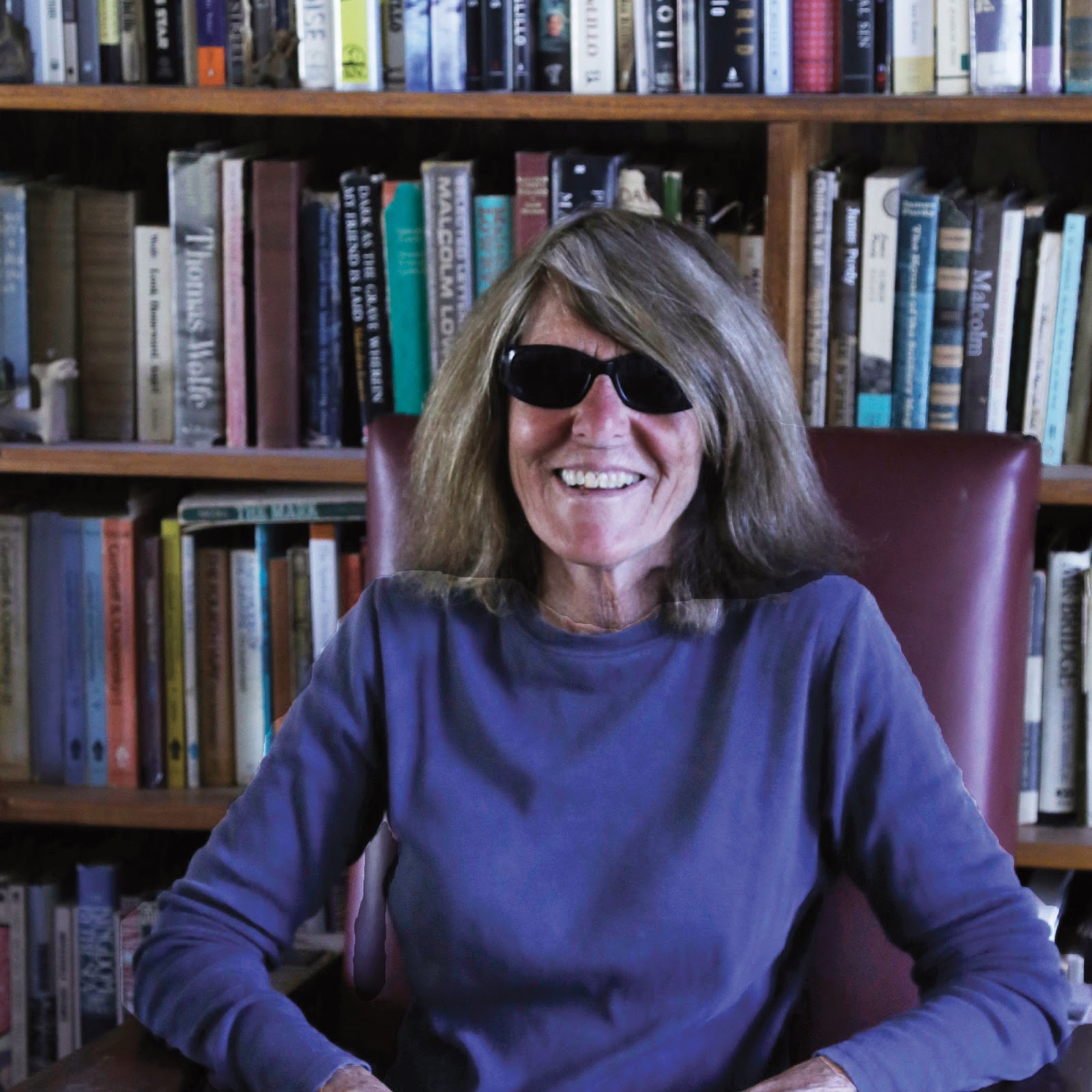
Joy Williams. Photo: Anne Dalton
Finished the third short story in Joy Williams's collection, The Visiting Privilege. 'Summer' (first printed in The New Yorker in 1981) is delightful; chronicling the events and personalities during five weeks of an August summer holiday on an island somewhere off the eastern coast of the USA. It is warm, affectionate and humorous with less of the underlying melancholy present in the first two stories in the book (although that seam is not entirely absent). The children leap off the page as unique, wholly believable, perfectly-drawn individuals. The women who come in succession to stay on five consecutive weekends are brilliantly presented with such economy that it takes your breath away. Steven, the author boyfriend to each of the five women, is never seen but I formed a picture of him nonetheless, laughing out loud on the one occasion we hear his voice through a resolutely closed door. Constance and Ben feel real and you think ... maybe I mean hope ... their love will endure (because of the final paragraph) despite the frailty of the human body.  

The story has the feel of memoir. Maybe it is, partly. But maybe it's entirely constructed from the writer's imagination. More likely, I suppose, it's an amalgam of both because isn't that what all fiction is, in the end? I chuckled quietly as I read, sitting under shade in our garden on a hot summer's day here in Canberra. I am beginning to feel in awe of Joy Williams and there are still forty stories to read in this collection. How could it have taken me thirty-five years to catch up to this story? And longer than that to find my way to Joy Williams in the first instance. Fool that I am.

Thursday, December 15, 2016

Lessons in Australian Drama

Much to my shame (if that's not too strong a condemnation) I know almost nothing about the history of Australian theatre but all that will change soon. I shall be taking a unit in Modern Australian Drama next semester at the ANU:
"The course aims to provide students with an introduction to some of the major developments in Australian drama and theatre in the twentieth century. Works by key playwrights, for example Seymour, Lawler, White, Kenna, Hewett, Buzo, Nowra, Williamson, Romeril, Hibberd, Gow and Davis will be studied both theoretically and practically. The plays chosen represent the wide range of subject matter and theatrical form that is evident in the modern Australian dramatic repertoire. In order to contextualise the plays studied, some examination will be given to more important elements of the stage history of Australia covering the last 50 years.
This course is designed to provide students with the opportunity to study theory through its practical application."
I'm looking forward to my late-starter introduction; particularly that last part. It seems we shall be learning by doing to some extent.


Dorothy Hewett: 1923 - 2002
We studied Dorothy Hewett's play, The Chapel Perilous, from the 1970s, as part of our 'Story to Screen' creative writing unit last semester. Although I knew nothing about the playwright (now I do) I was not surprised to learn of her Communist background (it takes one to know one, as we used to accuse one other, of all kinds of deviancy, when we were children.) Nor had I heard of the play, far less read it (although now I have, enjoyed it and secured a decent grade for my essay on the text - to my great relief). 

The play felt familiar nevertheless. It is, as some might say, 'of its age' but that 'age' - the 1970s - was my coming of age; emotionally, intellectually, politically as much as physically or chronologically. That was the decade I was exposed meaningfully to theatre for the first time; outside of the school curriculum, beyond the mainstream stage, in a Scotland that was re-inventing its theatrical tradition. It was a place and period of radical, iconoclastic, typically left-leaning drama that could be, at its best, electrifying and challenging in both its form and content. But it was also, very often, brilliant, engaging, and blissfully alive; full of fun, laughter, and music as well as piercing observation, searing critique and sometimes anger. Plays like The Cheviot, The Stag and The Black, Black Oil (1973) by 7:84 - a touchstone for anyone of my time; The Slab Boys by John Byrne performed at the impeccable Traverse in 1978; the hugely talented Russell Hunter as Jock, a one-man play for BBC Scotland; much later there were fantastic works like Mary Queen of Scots Got Her Head Chopped Off by Liz Lochhead, anything by the Communicado Theatre Group really, or the Trav's adaptation of Irvine Welsh's Trainspotting. Those earlier plays, however, shared much of the Brechtian, destabilising verve of The Chapel Perilous.

So ... I was pleased to stumble over an article with the (somewhat unwieldy) title, The great Australian plays: The Torrents, the Doll and the critical mass of Australian drama in The Conversation online. Helpful pre-semester reading. It should assist my exploration of a largely unknown (to me) dramatic tradition. We shall see where that leads.

Monday, December 12, 2016

Cay by Martin Pevsner

Another interesting read, the short story Cay by Martin Pevsner - winner of the 2016 Mogford Food and Drink Short Story Prize (this year's entries close 15th January 2017.) It fits with what might be the current zeitgeist for somewhat detached, observational writing. There's nothing much in the way of beginning, middle and end, in any order you care to think of; nothing at all in fact.

Martin Pevsner's web site is worth visiting.

Sunday, December 11, 2016

The Human Phonograph by Jonathan Tel

The site of China's first nuclear weapon research base in Haiyan county, Qinghai province.
From The Guardian:  Many years on... The site of China’s first nuclear weapon research base
Haiyan county, Qinghai province. Photograph: STRINGER/CHINA/REUTERS
Understated yet compelling writing. A short story by Jonathan Tel; winner of the Commonwealth short story prize 2015. Details of each year's competition may be found at Commonwealth Writers. 

The Human Phonograph can be read at the Guardian website. 

Monday, July 11, 2016

And today's word is ...

asseverate

It's a word I never knew existed until I read it in a short story, Monday or Tuesday, by Virginia Woolf. I had to look it up. Dictionary.com tells me it means,
1. to declare earnestly or solemnly; affirm positively; aver.
from the Latin assevērātus spoken in earnest (past participle of assevērāre)
Who knew?

Lord Byron by Thomas Phillips, 1813
Mrs. Woolf, obviously. And Thomas Moore, who used it in Volume 6 of his six-volume Life of Lord Byron (1854). My guess is Lord Byron also probably knew what the word meant. I doubt that I shall ever use asseverate in any other context but, as ever, I am indebted to Virginia Woolf. 

I could be being a smarty pants here: Perhaps a year before this portrait was completed Lady Caroline Lamb asseverated that her lover, Lord Byron, was "mad, bad, and dangerous to know." 

Allegedly.

Sunday, July 10, 2016

A society for asking questions

Virginia Woolf. Source: AP/Getty Images
Ninety-five years ago Virginia Woolf published a collection of short stories entitled Monday or Tuesday. I read the opening two stories earlier today. The first - a short, short story - is called 'A Haunted House'. It clearly draws directly on Mrs. Woolf's life and the deaths of her parents. One can see in it the core elements concerned with families and loss as well as time and place (especially the house in 'Time Passes') presented with such accomplishment and power in the novel To The Lighthouse, published six years later.

The second piece in the 1921 short-story collection goes by the title, 'A Society'. It's a comic tale, a satire I suppose, extolling feminist Utopian ideas which, almost one hundred years after publication, remains insightful and compelling. Like everything of Virginia Woolf's I have read it also shows her powerful intellect and perceptive skill. It is witty, self-deprecating at times and sharp throughout. It's impossible not to think that a Century later we still haven't reached the point Mrs. Woolf looked forward to in her short story.
by Aubrey Beardsley, 1895

I subsequently stumbled over (yet again and not for the last time) just how much I do not know and have yet to learn when I found an academic paper on Mrs. Woolf's short story online: 'A Society': An Aristophanic Comedy by Virginia Woolf' by Lucía P. Romero-Mariscal. I vaguely recall studying one of Aristophanes' plays forty years ago at Stirling University. It may have been Lysistrata but might have been The Birds. I still possess the book of the great dead Greek's plays I bought in 1975 or 1976; one of several paperbacks to see me through the semester on drama. 

Now ... I'm not entirely thick. With character names such as Cassandra and Castalia, and references to Sappho in her story I understood Virginia Woolf was making Classical allusions as well as many other observations. But I had no idea at all of the direct reference to and influence of Aristophanes' Lysistrata in 'A Society' until I read Ms. Romero-Mariscal's short, insightful and persuasively argued paper. So I came away from this evening's set of readings with clear impressions and observations, which include:
  • Every new encounter with Virginia Woolf's writing leaves me in awe of her talent and accomplishments;
  • I truly do know much less than I think I know;
  • I have a lot to learn;
  • Writing has as much to do with reading as it does with writing.

When I was reading Steal Like An Artist by Austin Kleon I was struck by a suggestion of his that one should "climb your own family tree". He described that idea in these terms,
"... chew on one thinker - writer, artist, activist, role model - you really love. Study everything there is to know about that thinker. Then find three people that thinker loved, and find out everything about them. Repeat this as many times as you can."
I surprised myself at the time by sticking an IKEA-equivalent of a post-it note to the page in Mr. Kleon's book (page 15, as it happens). I scribbled on my note, "who would that be?" I was stumped not because I don't have heroes and role models. I have many. Instead, I struggled with selecting my number one, my person of choice with whom to begin. Since reading Steal Like an Artist, however, the question has been answering itself because time after time after time I'm drawn back to Virginia Woolf. Who would have thought so? Well, me actually; now that I think about her place in the panoply of influences and talents from which I might choose. 

It seems, then, I've found the first of my next three 'thinkers' to explore (as I continue to mine the works of Virginia Woolf). So ... Aristophanes, here I come. I shall start by digging out the creased and worn paperback volume of Greek plays I've carried with me across two continents for more than forty years. Back to the future indeed.

Saturday, July 09, 2016

E Annie Proulx keeps moving

The writer's desk. Pic: John Freeman
Annie Proulx no longer lives in Wyoming (I may be one of the last people on the planet to know this fact but it's news to me). And she has a new novel out; Barkskins, which I shall add to the list of future-reads (university reading lists loom large in my current thinking; term starts in a week so I have other priorities).

I read those snippets of 'news' in an article, 'How The Writer Researches: Annie Proulx', in the online journal, The Literary Hub. The article is worth reading. It begins:

Annie Proulx is 80 years old and still not sure where she belongs. Standing in the atrium of her home in the Snoqualmie Valley, the Pulitzer Prize-winning novelist eyes a photograph of the cottage she once occupied in Newfoundland, the setting of her 1993 novel, The Shipping News. “I fell in love with that landscape,” Proulx says, speaking in the tone of a woman describing an ex-lover.
“But ultimately, I did not belong there.”
After 20 years in Wyoming—several spent building a dream home she later sold—Proulx had a similar epiphany about that state. As she did about Vermont, and Texas, and New Mexico, and any number of places where she has lived. In an age of itinerary writer-teachers, Proulx’s boomerangs back and forth across North America are exceptional.
Now she’s made a similar discovery of the wooded idyll east of Seattle.
 If it's true that Ms. Proulx remains unsure about where she belongs there may yet be hope for a 'young man' like me, teetering on the brink of sixty-something. Write on Douglas. Write on.

Sunday, May 15, 2016

Swift

Much to my surprise, I've been working on an essay for my ANU English Literature course on Jonathan Swift's A Modest Proposal. For many critics, it's Swift's most accomplished satirical short prose work. My jury has always been out on Swift and it remains out still. But there is a lot going on with this outrageous pastiche of the type of early-18th Century pamphlets that seemed to circulate endlessly, pointlessly and much too frequently among the chattering classes of Georgian England. It's no bad thing that I'm reappraising Swift to some degree. There's plenty I can learn and it's usually good to prove yourself wrong. It suggests you're still asking questions of yourself.

Here's Peter O'Toole reading A Modest Proposal on the occasion, thirty two years ago, of the re-opening of the Gaiety Theatre in Dublin. He was booed and there were walkouts. Nearly 300 years after Swift published his pamphlet anonymously, it seems his words still had and have the power to disrupt the cosy comfort of Ireland's middle classes.

Saturday, May 14, 2016

A Sonnet

I completed a sonnet, which will be my third poem for the portfolio of writing that's to be assessed for my creative writing course at the ANU. It's called, 'Is There an App for This?' Here's the first verse,


No txt emoji known to man or beast,
No night spent swiping left or right,
No ‘Fitbit’-measured heartbeat much increased
Placates the sad, rejected lover’s plight.

So that's all the first draft's completed.
  • Margaret and the Dali, a short-story
  • Good Lord, is that the time already?, a free form poem
  • Custodians, a vilanelle
  • Is There an App for This?, a sonnet
Final drafts and a two-page account of my editing decisions are required by the 2nd June. But we're leaving Australia, week after next, for five weeks in the northern hemisphere so I have to submit the finished portfolio before we go. After that we shall see what's what.

Thursday, May 12, 2016

I Know A Man


We discussed a poem I had not come across before in this afternoon's writing workshop at the ANU. Robert Creely's I know A Man.

As I sd to my
friend, because I am
always talking, -- John, I

sd, which was not his
name, the darkness sur-
rounds us, what

can we do against
it, or else, shall we &
why not, buy a goddamn big car,

drive, he sd, for
christ's sake, look
out where yr going. 

Written in 1954 or 1955 it inhabits the same world as that of the rest of the Beat poets; a world of jazz, drugs and alcohol, the crisis of confidence of American masculinity, and loss of control. Good stuff. I shall read more.

Monday, May 09, 2016

A vilanelle?

Today I completed the second of three poems I'm required to submit as part of the assessed work for my creative writing course at the ANU. We're asked to submit a free-verse poem and two others with more traditional, formal structures such as a vilanelle or sonnet. I finished and submitted the first, my vilanelle, this morning.  It's called Custodians, and this is how it starts:

Tomorrow is not ours to lose but keep, 
To hold, protect, and save from foolish men
So no dark days may make our children weep.

We shall see what they think.

Dylan Thomas
Source: University of Buffalo
And here - because one can - is the most famous vilanelle ever written. Thank you Dylan Thomas. The rest of us know how high we need to aim.

Do not go gentle into that good night

Do not go gentle into that good night,
Old age should burn and rave at close of day;
Rage, rage against the dying of the light.

Though wise men at their end know dark is right,
Because their words had forked no lightning they
Do not go gentle into that good night.

Good men, the last wave by, crying how bright
Their frail deeds might have danced in a green bay,
Rage, rage against the dying of the light.

Wild men who caught and sang the sun in flight,
And learn, too late, they grieved it on its way,
Do not go gentle into that good night.

Grave men, near death, who see with blinding sight
Blind eyes could blaze like meteors and be gay,
Rage, rage against the dying of the light.

And you, my father, there on the sad height,
Curse, bless, me now with your fierce tears, I pray.
Do not go gentle into that good night.
Rage, rage against the dying of the light.

Wednesday, April 27, 2016

Is there an authentic me?

For this week's reading response as part of my Digital Culture course at the Australian National University we are asked:
Is there an 'authentic' you? And if so, where? Does your online identity have anything to do with your 'real' identity, or do you make a distinction, if not, why? 
And here's my reply.

How can one know? 

Jacques Derrida.
Source: The Guardian 
I shall attempt an answer to your question(s) and mine but bear with me. There’s a risk I may be circuitous, even appear evasive, in my attempt to provide what ought to be an easy answer to a straightforward question.  Of course, there’s an authentic me, I instinctively assert (with scanter evidence than I’m entirely certain about). And yet, if I’m honest, those dead, white, 20th Century, French philosophers in Wednesday’s lecture (especially Derrida, I have to say, with his viral matrix, its two threads of disordered communication and undecidability) require me to pause, reflect, question my own assertion, hedge my bets in a way. Not quite answer.

Here’s where my problems start. 

First, there’s postmodernism. It’s not really an ‘-ism’ at all. No one really takes it seriously in the 21st Century. And yet … Second, there’s Derrida who just will not leave any thinking person alone with the comfortable, old world certainties (which I mean rhetorically or ironically) of Modernity’s Cartesian duality and the 18th Century Enlightenment, particularly (for me) the dimension one was raised to regard as its muscular, ‘ass-kicking’, let’s get the rational, empiricist show on the road variant, known as the Scottish Enlightenment (Hume, Smith, Carlyle, Watt to name but a few). And third, there is the slippery but essential method / tool / process / technique / concept (I’m never quite sure what signifier to use, which is the kind of postmodern, Derridan circularity that makes one scream at times) of deconstruction. Those threads leave an ageing Marxist floundering at times. The result is I respond to your question(s) not with answers but more questions. They may circle what looks like answer.

#1, What do we mean by authentic?
Source: The New Inquiry

Rob Horning thinks he knows. He writes (in his article 'Google Alert for the Soul') that we can no longer think of authenticity as,
fidelity to an inner truth about the self but fidelity to the self posited by the synthesis of data captured in social media - what I here call the data self. This sort of decentered authenticity posits a self entirely enmeshed in algorithmic controls, but it may also be the first step toward post-authenticity, 
I’m not so sure. So I start by turning to a dictionary to consider the different, perhaps overlapping or contradictory, readings of the signifier “authentic”. Thus:

1) “of undisputed origin or authorship; genuine”
  • I possess a 59-year old document that confirms Douglas Dougan Herd was born at 4:40 p.m. on the date of his birth at 1301 Govan Road, Glasgow.
  • On its reverse is written in fading ink that this Douglas Dougan Herd was “Baptised in the Name of the Father and of the Son and of the Holy Ghost” on 19th May 1957.
  • I also have a certificate of Australian citizenship dated 16th November 2006.
    • All genuine with verifiable authorship and of undisputed origin. Am I authentically Australian or Scottish? Can I be both simultaneously? 
    • I know I have no religious Faith of any sort but I was Baptised in a Christian church and raised through my formative years in the same traditions of Scottish Presbyterianism that drove the 18th Century Enlightenment. Baptised? Baptism no longer in operation? Didn’t he mention Marxist earlier? Who is this Douglas Dougan Herd? Does he know? Do we believe him?
2) “accurate in representation of the facts; trustworthy; reliable.”
  • How authentic can one’s identity be if an accurate representation of the facts suggests this Douglas Dougan Herd may not be trustworthy or reliable. For example, is this definition of authentic reconciled or destabilised by even a few facts (selected from a longer list from life)?
    • Twice divorced: accurate but ... trustworthy, reliable?
    • Arrested at the age of 17 by two Scottish police officers, jailed for a night, appeared in a Scottish court to answer charges of drunkenness and breach of the peace. Accurate, trustworthy and reliable. 
      • (I was found to be not guilty. Does that mean 2 authentic police officers lied? Yes. Most 17-year olds plead guilty, cop the fine and move on ‘cos, you know, who is a judge going to believe?)
    • Arrested, age 22, after being chased by six Scottish police officers, jailed for a night, fined £50 for breach of peace & disorderly conduct. 
      • (Organiser of student civil disobedience action against Apartheid rugby team tour. Pitch ‘invasion’.)
    • Subject of an MI5 counter-intelligence file along with many other political activists of the 1980s. 
      • (You would think MI5 had more important people to keep files on but apparently not.)
#2, Does your online identity have anything to do with your 'real' identity, or do you make a distinction, if not, why?
Douglas Rushkoff's polemic
Source: Wired

The first part of the question suggests a false dichotomy that cannot be sustained and is not helpful in the digital age. In as much as any person’s identity can be said to be real it must, in the contemporary world, encompass an online dimension as well as others that are no less constructed (see final part below).  This is one of the (several) areas in which I take issue with Douglas Rushkoff’s essay ‘Digiphrenia’, not least his rather disingenuous assertion that “people are still analog”. 

Well, yes but also no Mr. Rushkoff. Here’s how I think I know.
  • Paraphrasing William Shakespeare’s Shylock, ‘If you do prick me, do I not bleed’ (real, analogue Dougie)
  • Access Internet Banking (real, digital Dougie)
  • Buy online (book purchases, flights to Scotland, etc.) real, digital transactions to facilitate, expand and enrich the experience of real, analogue Dougie.
  • Post to social media daily (more or less) real, analogue Dougie’s construction of real, digital Dougie’s online presence, e.g.
    • Tweet on issues of political engagement (disability advocacy, anti-Trump, etc)
    • Facebook posts ranging from anti-Trump memes, disability advocacy, photos of tomatoes in the garden or our cat, Prince videos for obvious reasons. (digital traces and signs of the real analogue Dougie, his online networks and personal biases and preferences)
    • Blog, essentially a private journal because no one else reads it.
I contend that all of the above and more are constituent parts of the currently authentic me. But that idea of me is not the same as the idea of me twenty years ago and it won’t be me in ten years’ time (if I live that long).  As Irving Howe observed over 20 years ago,
Let us say that the self is a construct of mind, an hypothesis of being, socially formed even as it can be quickly turned against the very social formations that have brought it into birth 
Or almost. I think we construct, deconstruct and reconstruct our self continuously; in real time, in relationships with real people as well as online in networks, communities and virtual worlds. It’s called life. Sometimes it’s messy and hard to pin down. That’s not a bad thing.

Saturday, April 16, 2016

Who We Were by Lucy Neave

Order a copy here
So ... I finished reading the novel written by my creative writing teacher at the Australian National University. Here's an interview / profile of Lucy from the Sydney Morning Herald. 

What do I think? I'm not entirely sure. It's well-written - sparse, minimalist prose with a surprisingly detached tone (surprising given it's both a love story and a quasi-political thriller with spies, FBI raids and extra-marital sex on the lounge room floor - or was it the kitchen?) Maybe that tone reflects the post-traumatic distancing felt by the narrator; betrayed, back home in Australia, isolated and recalling events years after the events. Detachment is a tricky tone to sustain. 

What words would I use to describe the novel? Intriguing rather than compelling. Ambitious in what it strives to achieve, seeking to unite the personal stories with the politics and beat of another place and time. But not entirely successful in realising its commendable ambitions? 'Fraid so. It's a good, interesting read but at times I couldn't quite maintain a willing suspension of disbelief. Read it and judge for yourself because there are plenty of professional reviewers (some you can find on Lucy's web site here) and everyday readers (on the Good Reads web site here) who think differently.

Friday, April 15, 2016

Jane Eyre

The brilliant Mia Wasikowska as Jane Eyre
Watched a splendid adaptation of Jane Eyre, directed by Cary Joji Fukunaga. Anchored by a marvellous performance by Mia Wasikowska it also has excellent support from Michael Fassbinder, Judi Dench and Jamie Bell. Can a movie be better than the book it comes from? Probably not but this comes close. It's pared back, spare and manages the novel's implausible plot points well enough to keep intact your willing suspension of disbelief. Well worth watching.