Pages

Showing posts with label fiction. Show all posts

Tuesday, January 03, 2017

Summer by Joy Williams

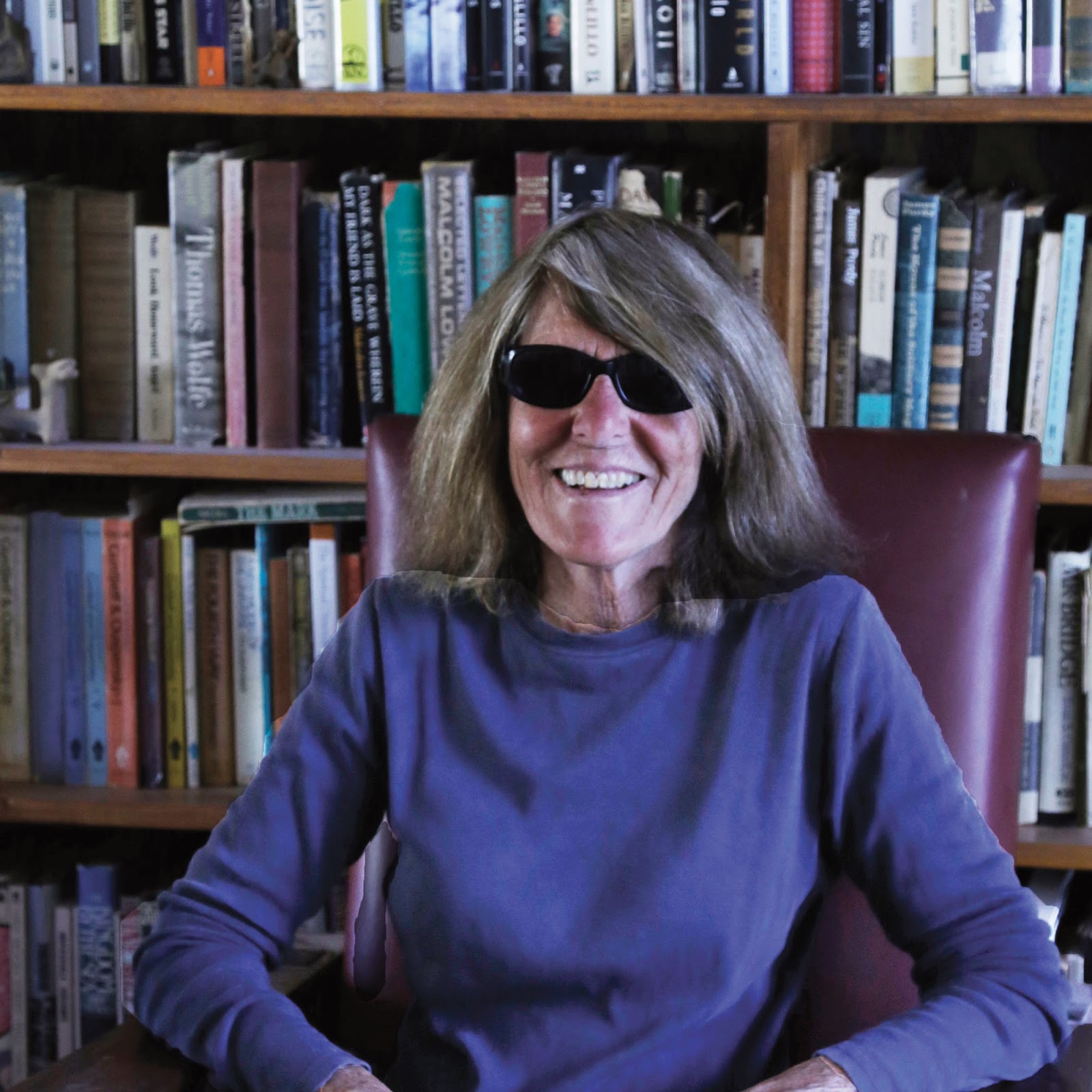
Joy Williams. Photo: Anne Dalton
Finished the third short story in Joy Williams's collection, The Visiting Privilege. 'Summer' (first printed in The New Yorker in 1981) is delightful; chronicling the events and personalities during five weeks of an August summer holiday on an island somewhere off the eastern coast of the USA. It is warm, affectionate and humorous with less of the underlying melancholy present in the first two stories in the book (although that seam is not entirely absent). The children leap off the page as unique, wholly believable, perfectly-drawn individuals. The women who come in succession to stay on five consecutive weekends are brilliantly presented with such economy that it takes your breath away. Steven, the author boyfriend to each of the five women, is never seen but I formed a picture of him nonetheless, laughing out loud on the one occasion we hear his voice through a resolutely closed door. Constance and Ben feel real and you think ... maybe I mean hope ... their love will endure (because of the final paragraph) despite the frailty of the human body.  

The story has the feel of memoir. Maybe it is, partly. But maybe it's entirely constructed from the writer's imagination. More likely, I suppose, it's an amalgam of both because isn't that what all fiction is, in the end? I chuckled quietly as I read, sitting under shade in our garden on a hot summer's day here in Canberra. I am beginning to feel in awe of Joy Williams and there are still forty stories to read in this collection. How could it have taken me thirty-five years to catch up to this story? And longer than that to find my way to Joy Williams in the first instance. Fool that I am.

Saturday, April 16, 2016

Who We Were by Lucy Neave

Order a copy here
So ... I finished reading the novel written by my creative writing teacher at the Australian National University. Here's an interview / profile of Lucy from the Sydney Morning Herald

What do I think? I'm not entirely sure. It's well-written - sparse, minimalist prose with a surprisingly detached tone (surprising given it's both a love story and a quasi-political thriller with spies, FBI raids and extra-marital sex on the lounge room floor - or was it the kitchen?) Maybe that tone reflects the post-traumatic distancing felt by the narrator; betrayed, back home in Australia, isolated and recalling events years after the events. Detachment is a tricky tone to sustain. 

What words would I use to describe the novel? Intriguing rather than compelling. Ambitious in what it strives to achieve, seeking to unite the personal stories with the politics and beat of another place and time. But not entirely successful in realising its commendable ambitions? 'Fraid so. It's a good, interesting read but at times I couldn't quite maintain a willing suspension of disbelief. Read it and judge for yourself because there are plenty of professional reviewers (some you can find on Lucy's web site here) and everyday readers (on the Good Reads web site here) who think differently.

Tuesday, February 09, 2016

John Gray o' Middleholm

James Hogg, 'the Ettrick Shepherd'
painted by Sir John Watson Gordon
Appropriately enough, I admit - dare one write confess? - I have never read The Private Memoirs and Confessions of a Justified Sinner by James Hogg. I know that I should have done before now but ... no excuse ... I just have not. I shall add it to the list.

Today I read one of his short stories, included in Philip Hensher's Penguin anthology. 'John Gray o' Middleholm' was published around 1820 or 1821 in a collection by Hogg which was titled, Winter Evening Tales, Collected Among the Cottagers in the South of Scotland. It must have been a popular enough two-volume collection because the version "Digitized by Google" is an 1821 Second Edition printed by Oliver & Boyd in Edinburgh.

Nearly two hundred years old, describing a lost Scotland and people whose lot has fallen into history mostly - home-based weavers, cobblers, the remnants of an agricultural peasantry 'John Gray' has more common - in an odd sense - with characters out of Mark Twain or Rip Van Winkle than with urban Scots or those from the Victorian-era onwards. 

It made me laugh in places, this moderately hokey tale of a Borders' ne'er-do-well, always short of money, always hungry with a long-suffering, gossiping and not very bright wife, too many children and daft ideas of the ways he'll rise above his lowly station. Is it a ghost-tale?  Not really although there is definitely an uncanny twist. Is it a homily to thrift and the rewards of hard work? Not at all, although a prodigious annual harvest of fruit might make you think so at first. Anyway, it's an enjoyable, gentle satire. Well worth reading, it has earned its place in Mr. Hensher's review of 250 years of British short story telling.

Friday, January 08, 2016

No single fact can ever define us - two strong women

Another two short stories from Philip Hensher's anthology bit the dust today; both by women whose long lives straddled the turn of 18th and 19th Centuries, both of whom experienced mental breakdown, both of whom survived their traumas to write.

HannahMore.jpg
Hannah More by Henry Pickersgill
Hannah Moore was born in 1745, the year of the Jacobite Rebellion.  She wrote plays, poems and short stories such as the morality tale, Betty Bridges, the St. Giles's Orange Girl.  It's too easy to observe that such a one-dimensional tale of the moral improvement made possible through hard work, thrift, respect for God's laws and the beneficent power of the philanthropic middle-classes could not be written today.  But it's just as true that Miss More wrote her short, unmistakably 'Dickensian' fable three years before the great chronicler of London's poor was born.  Hannah was a leader of the Bluestocking group (maybe not proto-feminist but certainly supportive of educated, intellectual, socially-conscious and engaged women).  And when it came to the great cause of her day - the abolition of the slave trade - Hannah More was on the right side of history.


Mary Lamb Portrait.jpg
Mary Lamb
Mary Lamb was born twenty years after Hannah More and lived to the middle of the 19th Century.  What sorts of changes must these two women have seen in their lives, each of more than eight decades?  It was an era of enormous change in the structure, economy, society of Great Britain - the great age of the industrial revolution that made Victorian Britain the largest Empire the world had ever known.  Where Hannah More's story centred on the misfortunes of the urban poor and the reforming efficacy of the emergent middle-class, Mary Lamb's nostalgic rumination on childhood, The Farm House, harked back, I think, to fabrications of a lost (perhaps never-existed) agrarian idyll. I was startled, then, to discover that aged 32 Mary Lamb stabbed to death her mother who was sitting at their dinner table.  Mary was convicted of lunacy, spending short periods in institutions throughout the rest of her life.  She and her brother Charles were, however, fully engaged members of London's literary life.

Saturday, January 02, 2016

Prometheus was not wrong

I'm going to start an online course next week, studying Shelley's Prometheus Unbound.  Before I do I thought I better acquaint myself with the great Romantic poet's inspirational source.  So, today, I read a version of Prometheus Bound taken from The Harvard Classics series with a translation by someone called Edward Haynes Plumptre (1821 - 1891).

Heracles freeing Prometheus from his torment by the eagle
We know the Titan was not wrong in what he foresaw.  Io accepted his vision of her future because he could recount her past correctly.  He knew where she had come from and could tell where she was going.  Prometheus could foresee the line of births that would lead from Io to Heracles and back, the circle completed, to the release of Prometheus from his chains.

So we know Prometheus was not wrong to reject the deal offered by Hermes. Recant and Zeus would set him free ... more accurately, release him from the shackles.  Continue to resist and Zeus would heap a "triple wave of ills" upon his head: buried alive in a ravine for an immeasurable age; exposed thereafter to the light so that the eagle of Zeus could feed each day on Prometheus's liver; finally cast into the dungeon Tartarus, lower even than the depth of Hades.

And Prometheus replied:

To me who knew it all
He hath this message borne;
And that a foe from foes
Should suffer is not strange.
Therefore on me be hurled
The sharp-edged wreath of fire;
And let heaven’s vault be stirred
With thunder and the blasts
Of fiercest winds; and earth
From its foundations strong,
E’en to its deepest roots,
Let storm-wind make to rock;
And let the ocean wave,
With wild and foaming surge,
Be heaped up to the paths
Where move the stars of heaven;
And to dark Tartaros
Let Him my carcase hurl,
With mighty blasts of force:
Yet me He shall not slay.

Friday, January 01, 2016

More short stories - back in the 18th Century

I read a couple of tales from Philip Hensher's anthology, both from the middle of the 18th Century.  Neither will make it into my list of all-time greats.  I'm not entirely persuaded they merit a place in a review of the British short story across 300 years of literary history.  Mr. Hensher concedes some of my reservations when he writes that,
"The first pieces in this anthology are not, in the modern sense, short stories  But they bear in a vital, animating way on the short story's historical development.  They are trying to distinguish themselves from the long form, and are drawing on a number of literary counter examples."
And I think ... maybe.  But Philip Hensher read many, many more short stories in preparing his anthology than I shall ever read (I suspect) so I'll take him at his word; accept his judgement.  That still doesn't make me any more enamoured of the second and third stories in his first volume, by Jonathan Swift and Henry Fielding.

Jonathan Swift by Charles Jervas detail.jpg
Jonathan Swift, by Charles Jervas
I'm not a fan of Jonathan Swift.  For reasons that surprise me I struggle a bit with satirical writing generally and with Swift in particular.  I'm not entirely sure why that is; something to do, perhaps, with the way it ages so very quickly. That and what I think of as a fine line between satire on the one hand and cynicism, condescension and even misanthropy on the other.  Jonathan Swift, I've long felt, tends towards all three of the latter.  

Gulliver's Travels has always struck me as a distasteful book and it's not a surprise that most attention has been given to the first two adventures (often in a form rendered safe for children).  By the time you encounter the Yahoos I think we're in thoroughly unsavoury territory, even for its time.

Reading Directions to the Footman didn't do anything to rehabilitate Swift in my mind.  Its condescending, nasty tone was never going to appeal to me.  He may be mocking some of the absurdities of the British class system in 18th Century England but he does so by laughing at the servant classes first and foremost.  Make up your own mind: you can read it here

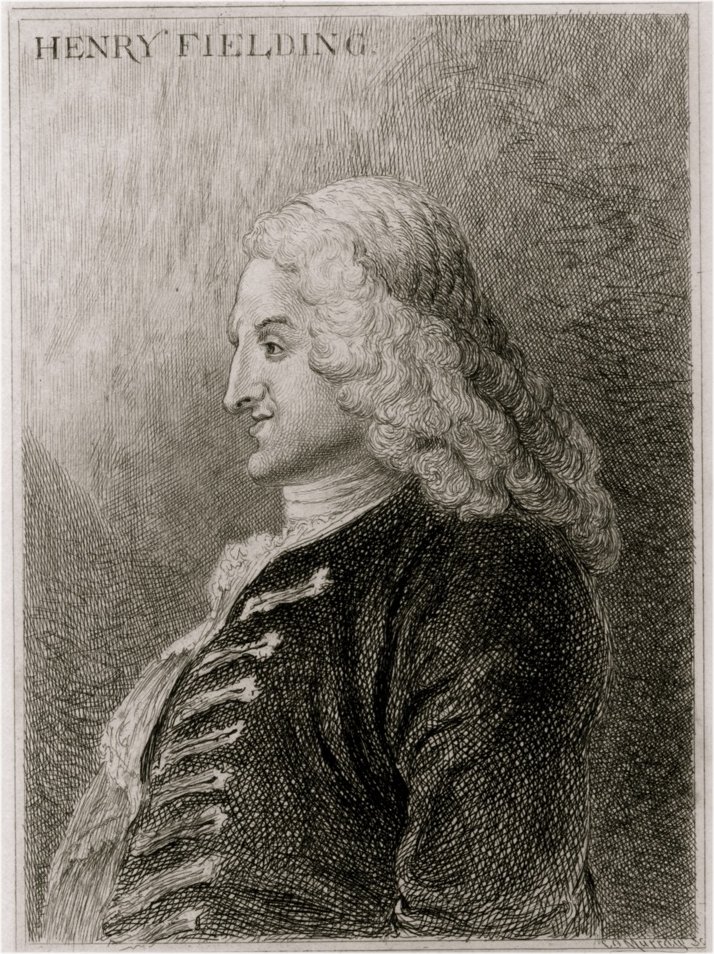
Henry Fielding, etching by Jonathan Wild
Henry Fielding's story The Female Husband seems to me to have all kinds of story-telling problems; too many, I feel, to be contained within the twenty or so pages the tale takes.  Maybe Fielding could get away with it in his longer fiction.  I don't know because I've never read any of it.  Is that a shocking admission for a man with my pretensions to make?  Probably.  Now I suppose I shall have to read Tom Jones.  As unlikely a tale as The Female Husband may be, it turns out its origins lay in historical fact, which wiki sets out here.  Shows me how wrong I can be.

Tuesday, December 29, 2015

Reading The Beach Boy in this week's New Yorker

PHOTOGRAPH BY DAVID BRANDON GEETING FOR THE NEW YORKER
DESIGN BY TAMARA SHOPSIN
And today's short story brings me right up to date although there is a sense, perhaps, it exists as a remnant of a bygone or fading age; the era of the literary journal, the printed magazine, a periodical.  In this instance The New Yorker.

In his General Introduction to The Penguin Book of the British Short Story Philip Hensher writes of the part played by magazines and journals in promoting and sustaining short story writing before lamenting the decline of such periodical platforms.  There has ensued, he argues, both a loss of engagement with the form and a change of focus (from magazine to competition as the dominant but distorting platform) for those who write short stories.  Mr. Hensher writes,
"For the greater part of the short story's history in Britain, the main publishers of short fiction were the editors of magazines and journals ... Blackwood's, Chamber's Edinburgh Journal, Household Words, All the Year Round, Cassell's, The Fortnightly Review, The Strand, ..."
then continues,
"The possibilities for the writer of short stories have narrowed significantly in recent years. Where once there was any number of paying journals ... now the principal outlet for many writers of short stories is not publication but competitions."
before concluding this thread of his Introduction with the mildly depressing observation that,
"There are very few outlets still able to pay a writer for a short story in a way that could encourage a writer to persist, and with the sort of editorial investment that will enable a writer to develop. Most of them are in the United States. The New Yorker has, happily, been able to develop the short-story writing careers of two of the best short-story writers now at work, Tessa Hadley and Zadie Smith.  There is no British journal that would have published Hadley's stories, as the New Yorker has, twenty-one times, and paid properly for them."
These are reasonable observations, accurately describing a decline in printed publication that's clear and regrettable, I'm sure.  Oddly, however, it seem to me almost nothing is said by Mr. Hensher about the role now played by online platforms.  There is, I think, a sense in which his Introduction limits itself to a lament for the lost era of publishing newspapers, magazines, journals, etc in hard copy forms.  And that's fair enough - up to a point.  For those of us of a certain age that's how it has been for most of our lives and for centuries before us.  But ten years from now not even The New Yorker will survive in hard copy, printed format.  We'll still be reading short stories though, online in new-form periodicals and journals.  Who knows, there may even be a renaissance of the short story?

None of which is what I originally came here to write about today.  


Ottessa Moshfegh.
Otessa Moshfegh. Photo by Krystal Griffiths
I came to note the engaging, intriguing short story I read in The New Yorker as it happens (which explains my ruminations above).  It's a story called The Beach Boy by Otessa Moshfegh (of whom I had never heard until I visited this week's New Yorker site - which only tells you something about my lack of knowledge).  There's a detached alienation to the narrative voice in the story; a sense of fin de siècle anomie (if that's not too daft a notion given the date).  In a Q&A article linked to the publication of the story Ms. Moshfegh talks of her interest in "repressed Western consciousness" around which her story circulates in a seductive way.  Like most of the contents of The New Yorker the story is well worth reading, and not simply as a contemporary contrast to something like Defoe's work (yesterday) from 300 years ago but as a good read in its own right.

Monday, December 28, 2015

Beginning with a ghost story

Today I opened the first of (probably too many) books I bought before Christmas to read during my three weeks off work.  When I originally read in The Guardian about The Penguin Book of the British Short Story, edited by Philip Hensher, I could hardly contain myself. (I'm not quite sure why that should be.)  

As one does in Australia, where books are unreasonably expensive due to restrictive wholesaler practices, I sped off to the Book Depository, placed my order for the two, lovely hardback volumes then waited - until today.  Keen for the books to arrive I suppressed my impatience by listening to Philip Hensher discuss the work with Claire Armitstead on the Guardian's Books podcast.  This much I learned from their conversation: whatever else I read in the anthology I am already in its editor's debt for pointing me in the direction of a 'lost' tale entitled The Forty Litre Monkey.  If that prospect doesn't entice you, nothing will. 

The first story in the anthology is Daniel Defoe's A True Relation of the Apparition of one Mrs. Veal, the next Day after her Death: to one Mrs. Bargrave at Canterbury. The 8th of September, 1705.  Snappy title.  Not surprisingly, given the British tradition, it's a ghost story.  According to wiki it's thought to be the first modern ghost story and I have no doubt Mr. Hensher sees it that way too.  The early date and theme make the story, published anonymously as a pamphlet in 1705, an ideal place to begin.

I've not read much by Daniel Defoe.  Any boy from my time and background would, of course, have read Robinson Crusoe.  Man Friday lives with us forever.  I'm pretty sure I first read the novel in an abridged, children's version presumably stripped of the worst excesses of its 18th Century racism.  I read the unabridged text years later but it's the children's version I recall best; not to forget the classic black and white TV series of the 1960s, which I remember mostly for its stirring signature tune.  In my defence I can only tell you I was seven years old when it was broadcast in 1964.  Many years later, as a student at Sydney University, I read Roxana, or to give this early, surprisingly proto-feminist yarn its full name, The Fortunate Mistress: Or, A History of the Life and Vast Variety of Fortunes of Mademoiselle de Beleau, Afterwards Called the Countess de Wintselsheim, in Germany, Being the Person known by the Name of the Lady Roxana, in the Time of King Charles II.  Another snappy title, although, to be fair to Defoe, such was the practice in the early days of the novel.

It's no great surprise then that I'd never read the story of Mrs. Veal's apparition.  But it's a good place to start a two-volume set of 90 short stories of British origin spread across nearly 300 years.  I'm looking forward to all that follows, not least the stories by writers I've never heard of before.  So far - day one - I've read Mr. Hensher's 'General Introduction' and Defoe's ghost story (which predates, to illustrate a point, M Night Shyamalan's movie The Sixth Sense by 296 years).  Already it's clear my purchase is money well spent.

Saturday, March 21, 2015

Reading The Observer's 100 Best Novels

Two books arrived today - Neil Gaiman's new collection of short stories, Trigger Warning: Short Fictions & Disturbances and an edition of The Pilgrim's Progress, parts I & II with the original illustrations.  I'm very pleased to receive the latter.  Neil Gaiman's book is for Spike.  I may read it sometime.  Or not.

I've decided to read all the novels on Robert McCrum's list of the 100 best novels ever written in Engish.  Such lists are, of course, arbitrary; a fact readily acknowled by Robert McC in his introduction to the series here.  That's neither here nor there, IMHO.  We all compile lists - favourite this, most disliked that, the tedious 'bucket list' and many more besides.  We pick and choose.  

Each week I read the article introducing The Observer team's pick of that week.  This week in a list that's ordered chronologically we've reached book number 78, To Kill A Mockingbird.  I've read 25 of the list announced so far which strikes me as pretty poor form; about one-third.  So I've decided to read or re-read the entire list in the chronological order it has been suggested to us.  Hence the arrival of the Bunyan, which I read a very long time ago - as an early teenager - perhaps in an abridged format.  I have a vague recollection of a children's version which, I speculate, my parents would have thought educational and improving for a child of still tender years (I may have been ten or eleven, so not even a teenager).

I flicked through the pages of the edition I received today (I remain surprised that anyone makes deliveries on a Saturday but I'll stop talking about that rather dim-witted surprise some day soon).  The illustrations are familiar.  They must have been in the children's version I read maybe 45 or more years ago.  And when I read the first paragraph (before setting down the book to return to reading the Guardian online over breakfast) I had an unmistakable and strong sense of having been there before, inside Christian's head, hearing his voice speak to me 300 years after the author set them down on paper.  I guess it's that sort of literary power that makes any writing a candidate for appearing on lists.  We'll see as I read it.

Wednesday, March 18, 2015

The Stranger's Child by Alan Hollinghurst

Mid-March and only now have I managed to finish reading my first novel of 2015.  Shame on you Douglas Herd.  It's also my first Alan Hollinghurst book. I'm not quite sure how I reached my grand old age without having opened anything by an author universally acclaimed as one of England's finest.  Better late than never (which may be my motto ... or an inadequate apology).

The Stranger's Child is a compelling read, superbly constructed around five episodes taking place at key moments of social, cultural and personal transition, loss or recollection in the lives of characters connected directly and indirectly over a span of 90 years.  I had my doubts at the outset, 1913 upper middle class England, thinking, did not Virginia Woolf get there first and better?  But I hadn't grasped the point.  As we move from each carefully constructed, beautifully written scene to the next the novel's scope expands and diversifies and yet the individuality of the human stories at the heart of the novel don't get lost.  As the novel's driving force - Alfred Hitchcock invented the idea of the McGuffin to describe the force that propels the narrative, like the Grail in a Grail quest - Cecil Valance, the handsome, lost war poet, recedes from view Alan Hollinghurst opens up a fascinating and entertaining examination of loss, memory, secrets and lies, artistic endeavour and changing tastes, reputation, social status, mores and change.  And if all that makes the novel sound dry and literary that only tells you I'm not a very good critic.

Much more accomplished reviews of a fine novel are available here in The New York Times and here (as you might expect) in The Guardian.

Monday, March 09, 2015

Sarah Braunstein's All You Have to Do

Pic: Grant Cornett / Hand Lettering: Mousecake
I read Sarah Braunstein's compelling short story in The New Yorker here.  As I read I listened to the accompanying sound file with the writer reading her story.  (Does that count as me reading - which I was - if the audio file was running too?)

It's a good read.  Short stories are meant to include a twist at the end and Sarah B delivers one - for this modern age of ours - but credible nevertheless.  The story is set in an unnamed town in 1972 when the central character Sid Baumwell is, we're told, sixteen.  I was fifteen that year so the story touches on a familiar period of awkward adolescence.  Sarah B captures that time, those emotions, the uncertainty and the smothering small town feel of Sid's situation very well.  It wasn't hard to suspend disbelief and go with the flow,  I laughed more than once - at the continuous repetition of "Sid said", the magnitude of a life time's supply of aluminium foil, the awfulness we wrongly find as teenagers in family life - and the slight twist at the end made me pause to think about how a comfortable and safe growing up (such as I enjoyed) sometimes, perhaps always, hangs on fragile, invisible threads which, if we're lucky in our growing up (as I was too) we seldom notice.

Well worth reading.

Sarah Braunstein's web site is here.

Wednesday, December 24, 2014

It was 171 years ago this very night ...

A Christmas Carol by Charles Dickens
I have endeavoured in this Ghostly little book, to raise the Ghost of an Idea, which shall not put my readers out of humour with themselves, with each other, with the season, or with me. May it haunt their houses pleasantly, and no one wish to lay it.

Their faithful Friend and Servant, 
C.D.

December, 1843.

Sunday, December 21, 2014

Beatrice and Virgil

I finished Yann Martel's third novel today; Beatrice and Virgil.  It's the first of his works I've read which is, I suppose, a mildly sacrilegious statement to make if you want to lay claim (as I do) to an interest in literature.  How could you not have read Life of Pi, Douglas?  At your age?  Dunno, is all I can tell you although I did see the movie.  Will that get me off the hook?  Probably not because I was drawn principally by the fact it was directed by Ang Lee. As an aside - the film is still the best 3D movie I've seen; truly astounding in places, visually breathtaking.


Back to Beatrice and Virgil, though.  It's somehow both ambitious and timid; daring in the idea that underpins the novel but it bottles out.  It's simple really - if you're going to toy with the conceit of an allegorical tale about the Holocaust I think you need to commit entirely to the idea or you're bound to end up falling short of your ambition.  Animal allegories can and do work.  Animal Farm works.  Watership Down works.  Beatrice and Virgil doesn't work and the problem is the injection of the quasi-realist but barely plausible tale about the blocked writer and old taxidermist.  It keeps butting into and undermining the animal allegory.  

There's also a problem - for me anyway - with the allegorical part.  This may seem a bit harsh - and I accept that only on the day I have ANYTHING published will I posses even an ounce of credibility when it comes to literary criticism - but when you read Mr Martel's frankly derivative script for the 'lost' play you realise again how remarkable and brilliant is Samuel Beckett's Waiting For Godot (on which '20th Century Shirt' seems - too obviously - to be based).

I liked these components:
  •  The writer's idea and ambition, neither of which were sufficiently realised. (sadly).
  • "The use of animals in his novel, he explained, was for reasons of craft rather than sentiment. Speaking before his tribe, naked, he was only human and therefore possibly - likely - surely a liar. But dressed in furs and feathers, he became a shaman and spoke a greater truth. We are cynical about our own species, but less so about animals, especially wild ones. We might not shelter them from habitat destruction, but we do tend to shelter them from excessive irony." pages 29 - 30
  • The games for Gustav, the most effective and affecting section of the novel.  Its few pages sit in stark contrast to everything that preceded them; a reminder, in a sense, of what doesn't work in what came before.
  • The initial description of the back room at the taxidermist's shop.
So ... a bit of a disappointment but I hold on to my high hopes for Pi.

An afterthought.  It's not Yann Martel's fault he received - if the story is true - an advance of maybe $2 Million or $3 Million for this novel, the follow-up to Life of Pi.  But it's hard not to imagine the panic that must have descended on the commissioning editor or publisher when the draft was submitted.  
"$3 Million in advance for this ... ? Oh shit!"

Saturday, December 06, 2014

Donald Westlake, a name to remember

The thunder storms continue; our third in four days and just as big a storm as those before.  There was nowhere to go in such wild weather and nothing sensible to do but shelter here at home, surfing the Internet, reading and inevitably - for me - watching movies.  I stumbled across a mildly ridiculous, violent heist / caper film by the name of Parker, directed by Taylor Hackford.  To describe it as implausible and full of plot holes one could drive a bus through would do a disservice to the very idea of implausibility.  It is as cheesy as Emmental.  But the rain poured down out of angry skies and there was nothing more appealing to download so I watched it to the grim and violent end.  I can't say I'd recommend it but that's not my point here.

The end-credits started with "IN MEMORY OF DONALD E WESTLAKE", a name I thought I recognised vaguely but as the credits rolled I couldn't see any further reference in the list of cast or crew.  So I googled ... as one does.

Donald Edwin Westlake is here.

Donald E Westlake
He's described on the fan web site as "crime novelist and Mystery Writers of America Grand Master Donald E. Westlake, creator of John Dortmunder, the most clever and least lucky thief in crime fiction, and, writing as Richard Stark, the hard-boiled heist master Parker."  The sentence doesn't quite do justice to a pulp fiction author who produced over 100 books in his writing life with up to 16 pseudonyms.  Sixteen?

As I read more about him (primarily on Wiki) I found two references to work he'd created that might have provoked my vague recollection.  The first was the movie The Grifters for which Donald Westlake wrote the screenplay and was nominated for an Oscar.  It's hard to believe that the Oscar went to Dances With Wolves ... actually it's not that hard.  It is, after all, the Oscars.  But The Grifters is a brilliant movie with a fiercely good screenplay.

The second point of reference goes much further back, all the way back to 1967 and Point Blank, John Boorman's movie version of Donald Westlake's novel (writing as Richard Stark) The Hunter.  I couldn't have seen it, of course, in 1967.  I was only 10 years old but I must have seen it somewhere, some time after.  It's a brutal story.  There are memorable scenes, especially the brilliantly edited long walk down the corridor as Walker / Parker makes his way to where his wife and her lover are supposed to be hiding out.  And the fight, which Walker loses, with Angie Dickinson's character - all those electric appliances drilling their sounds into Lee Marvin's cool killer's brain.

You can see the roots of Jason Statham's Parker in Lee Marvin's Walker but the 2013 version is a long way from the original and much diluted.  And if you're looking for menace and an animlistic, dangerous presence on screen you wouldn't look anywhere else but Lee Marvin in 1967. But the core of both lies in the writing of Donald Westlake I suppose.  I've never read any of his 100 plus works.  Maybe I should.

Monday, December 01, 2014

Not merely Kafkaesque ...

I read The Metamorphosis this morning.  It takes barely any time.

You can't do anything but admire the way Franz Kafka gets right to the heart of the matter with the opening sentence, "One morning, when Gregor Samsa woke from troubled dreams, he found himself transformed in his bed into a horrible vermin."  There's no preamble, no context-setting and, as we discover when we've finished reading, not even the vaguest notion or slightest nod towards an explanation of the transformation.  One morning a man called Gregor awoke in his bed as an insect.  Read on, says the author.  That's as much background as you need.

I'm intrigued by the ways in which Kafka builds a compelling idea of Gregor the vermin as a physically repulsive creature from whose sight - or the idea of seeing - we instinctively recoil just like his family, the maid and the office's chief clerk.  Gregor the human remains an essentially decent, empathetic being.  But we don't like the bug.

It's such clever, accomplished writing because we're only given physical description in fragments, at different points of the story.  We catch glimpses of the legs, the back, the head but we're never given a portrait of the creature as a whole.  Our imagination, maybe our instinctive fear, is left to fill in the blanks.  As readers, I suspect we do most of the work to join the dots of constructing the vermin that worries us most.  I saw a cockroach as soon as Gregor struggled to get off his back.  The cleaning lady in the story calls him a dung beetle.  Vladimir Nabokov - a lepidopterist - was adamant that Gregor was neither a cockroach nor a dung-beetle (an "epithet only to be friendly" apparently) but a big, brown, six-legged beetle (even though Kafka never enumerates Gregor's legs).  I have no wish to contradict one of the greatest writers of 20th Century literature but I believe Mr Nabokov proves my point.  Kafka never fully describes the vermin into which Gregor is transformed so as readers - even a reader as renowned as Vladimir - we construct the bug that works for us. 

Franz Kafka
I really do not like cockroaches.  Some visceral part of me is triggered when I see one - or two, as the case has been in our house over the last week or so thanks to heavy rain or moving cardboard boxes or whatever disturbs those ugly wee brutes.  So - SPOILER ALERT IN CASE ANYONE HAS NOT READ THE STORY - I was even more impressed by Kafka's writing when I felt loss, sadness and sympathy for Gregor at his end.  

In real life I'd feel no qualms at crushing any cockroach that provokes me simply by being and being visible.  Kafka, however, may have intended me to reflect on what Gregor's story tells us.  The facts of his life are pretty straightforward we're told.  Life is absurd, inexplicable and short.

Friday, November 28, 2014

Oranges are not the Only Fruit

Finally, nearly 30 years after Jeanette Winterson's first novel was published, I have finished reading it.  You have to forgive me if I missed it first time round.  I was still in spinal rehab or had just been discharged from Edenhall Spinal Injuries Unit in Musselburgh, ten months after my accident.  As excuses go it will suffice, I hope.  "Broke my neck in two places, officer.  Wasn't reading that much to be honest."

But what about the intervening three decades?  Good question.

It's not that I've not read anything by Jeanette.  I read - and fell in love with - The Passion when I studied it as part of an undergraduate literature course at the University of Sydney.  But even that was a bit delayed. The course ran in 2012.  The novel was published in 1987.  Of course, I read anything Jeanette writes in The Guardian.  And I subscribe to her web site's discussion forum.  So I'm not entirely beyond the pale.  

I even have more recent works sitting on my 'waiting-to-be-read-shelf'.  It may have been that fact which drove me back to the beginning (not in the way of T S Eliot's Little Gidding in Four Quartets, although there is a thread uniting the two oddly enough).  But having ordered and received through the post from the Book Depository The Daylight Gate (2012) I thought that maybe I should read earlier works first. Given my past performance, mind you, I am likely to start reading my latest Winterson purchase in about 29 years.  Will I still be reading in 2043?  I may have been dead for some time by then so reading may be beyond a man of even my skill set.  But then again, I would be 86; two years older than my mother is now and - shock, horror - she still reads, so it's not entirely beyond the realm of possibility.  But that's not what I came here to talk about.  I came to talk about Oranges ...

Fabby (which is an often under-used term in literary criticism) Eff - eh - bee - bee - wi.

What do I love? The voice, wit, humour, seriousness, acute sense of place and time and people, an eye for the absurd without any hint of cruelty or condescension, the interplay between different forms and the mixture of genres - autobiography, reportage, memoir, observation, fantasy, fairy tale and romance all wrapped neatly in a piece of self-aware metafiction.  I like the tone and the ambition.  I love the bravado: if you're going to play post-modern games of intertextuality why not do your intertextualising with The Holy Bible, Le Morte d'Arthur and Jane Eyre?

If the novel - is it a novel? - has a flaw it may be (for me at any rate) the leap and the speed of that leap from the micro-detail of everyday existence, family and community life of the first 5 chapters to the ruminations of the final chapter.  But that may just have been greed on my part.  I would have enjoyed more of the Bildungsroman before I got to the coda. But I'm nit-picking and besides, what would I know?

You feel you're in the presence of a courageous, inventive and confident writing mind when suddenly you come upon this: 

"Whelks are strange and comforting.
They have no notion of community life and they breed very quietly.
But they have a strong sense of personal dignity.
Even lying face down in a tray of vinegar there is something noble about a whelk. Which cannot be said for everybody."


The writer who gave us those words in her first novel either had no idea what she was doing or a wholly justifiable self-condidence.  I choose to believe it's the latter.


Saturday, August 18, 2012

Me and Norma Jean

Finished it.  At last!

Was it worth it?  Yes, truly amazing.  Did I get it all? Less than I think I did, much less.  I'll pay closer attention next time round.

Tuesday, July 31, 2012

Imagining America


My university study proper resumed today with the first classes of my literature unit (Imagining America, led by Dr David Kelly with whom I’ve studied previously – his Literature and Cinema course on book to film adaptations).  Typically (for me) I mossed the first class, a one hour lecture, thanks to a meeting running over at work.  I suppose I can’t complain too much.  NDS is allowing me the flexibility I need to study at all.  But I’ll try hard in the future not to miss classes.  I did make it to the first of our weekly two-hour seminars; this week an introduction to the course as a whole.  I volunteered to take the first week’s seminar topic (next Tuesday) on Walt Whitman with a particular focus on The Song of Myself.  I was the only person to put my hand up for Whitman, which I was rather pleased about.  I’m not keen on undergraduate group work.  To be honest, it’s because every time it’s foisted upon me my mark drops a notch or two. 

This afternoon we discussed the idea of America, considered within the context of American Exceptionalism and ‘the American experiment’ in nationhood and nation-building.  There were divergent views on the extent to which the exceptionalism notion still features in contemporary political philosophy (as distinct from current political discourse).  I tended towards that remains live within both philosophy and discourse (thinking of Bush and the Neo-Cons not so long ago or the Tea Party today).  A couple of my fellow students argued a similar perspective (with a sounder base in fact than I offered).  Dr Kelly saw it as less real in the current political philosophies at play in modern America although still a strong driver in the public discourse of candidates competing for office.  He argued (I think) that we’re in a different phase, beyond the triumphant and imperialist march of the great 20th Century powerhouse, although the USA remains a great power but the hegemony of the white, Anglo-Saxon Protestant elite that emerged from the ‘founding fathers’ is waning (Dr Kelly suggests) as the nation fragments, diversifies and re-considers internally its foundation myths while, economically and culturally, the idea of American hegemony in a globalised economy as reached its limits. 

Rip Van Winkle by John Howe
We started our literary examination of an imagined America with Washington Irving’s Rip Van Winkle.  I read the story as a child.  The only part that stuck with me was the part about the man who falls asleep for 20 years.  I remember it as a modern fairy tale – Dr Kelly used the term ‘tall tale’ which has more meaning in the American context; that’s the tradition Faulkner was invoking with As I Lay Dying. Although I read the story before the class and was able to offer some analysis and interpretation of it – particularly around the portrayal of women, the soft spot it exhibits for the laconic, ne’er do well male hero, the reassurance of continuity and progress around or across the bifurcating disruption of the long sleep, among others - I was struck by the differences between Dr K’s much closer, more analytical reading of the text than I could manage.  I realise, of course, that he’s a full time academic at a major institution and that American literature is one of his areas of interest.  Nevertheless, I should have been able to see more than I did.  My reading must become more analytical.  I need to become more rigorous in asking myself what’s going on and seeing the answers present in the text.  So I didn’t adequately describe the contrast in women’s roles before and after the big sleep (Dame Van Winkle may be a shrew but she has agency; Rip Van Winkle’s daughter is domesticated and nurtures the next male generation).  I didn’t see the satire on the monarchy or on the transfer of power from King George to George Washington (asking the question, to what extent has circumstances truly changed / improved for ordinary people?).

The point is this: I must sharpen my powers of observation.  I need to see better what it is that’s going on inside a text, not simply what’s happening with or to the story or its characters.  I’m looking forward to the rest of the semester.  I may even learn something.
Monday, July 09, 2012

The Murders of the Rue Morgue

Charles Gemora plays the ape in the 1932 film
What a weird little tale, so entirely dependent upon the exotic, orientalism of an Orang Utan from Borneo; an animal that could not have been well-known in 1841 from a place that most readers would have known almost nothing about (if they knew anything at all).  I was about half way through reading the tale when I remembered that I read it once before, years and years ago, probably when I was a teenager.

It seems so quaintly old-fashioned despite its graphic, Gothic imagery of violence.  When it was published though, it must have been read as shockingly modern.  Did Poe invent the private detective with his character Dupin?  He pre-dates Sherlock Holmes by nearly fifty years and must surely have been part of Conan Doyle's thinking as he constructed the acutely perceptive, supremely analytical Holmes.

Monday, July 02, 2012

Another cheery tale from Poe

Opium this time, rather than alcohol.  A dying woman confined in a turret rather than entombed in a wall.  A guilt-stricken narrator.  And a Gothic sensibility that pre-dates the Hammer Horror films of the 1960s by more than 120 years.  How Gothic can an author be and yet get away with it?  Try this from Ligeia:

Ligeia at ebooks@adelaide
The room lay in a high turret of the castellated abbey, was pentagonal in shape, and of capacious size. Occupying the whole southern face of the pentagon was the sole window — an immense sheet of unbroken glass from Venice — a single pane, and tinted of a leaden hue, so that the rays of either the sun or moon, passing through it, fell with a ghastly lustre on the objects within. Over the upper portion of this huge window, extended the trellice-work of an aged vine, which clambered up the massy walls of the turret. The ceiling, of gloomy-looking oak, was excessively lofty, vaulted, and elaborately fretted with the wildest and most grotesque specimens of a semi-Gothic, semi-Druidical device. From out the most central recess of this melancholy vaulting, depended, by a single chain of gold with long links, a huge censer of the same metal, Saracenic in pattern, and with many perforations so contrived that there writhed in and out of them, as if endued with a serpent vitality, a continual succession of parti-colored fires.

The odd thing (it seems odd to me) about these Gothic tales (and the doom-laden poetry) is that they were mostly written before Virginia's death, not after.  In 1838 when Ligeia was written or 1845 (The Black Cat and The Raven) the horror of a young wife's death had not been visited upon Poe.  If the chronology had been reversed, the wife's death (aged 25) then the Gothic writing, one might see a possible point of origin.  But that's not how Poe's story went, so where did the tales spring from, I wonder?